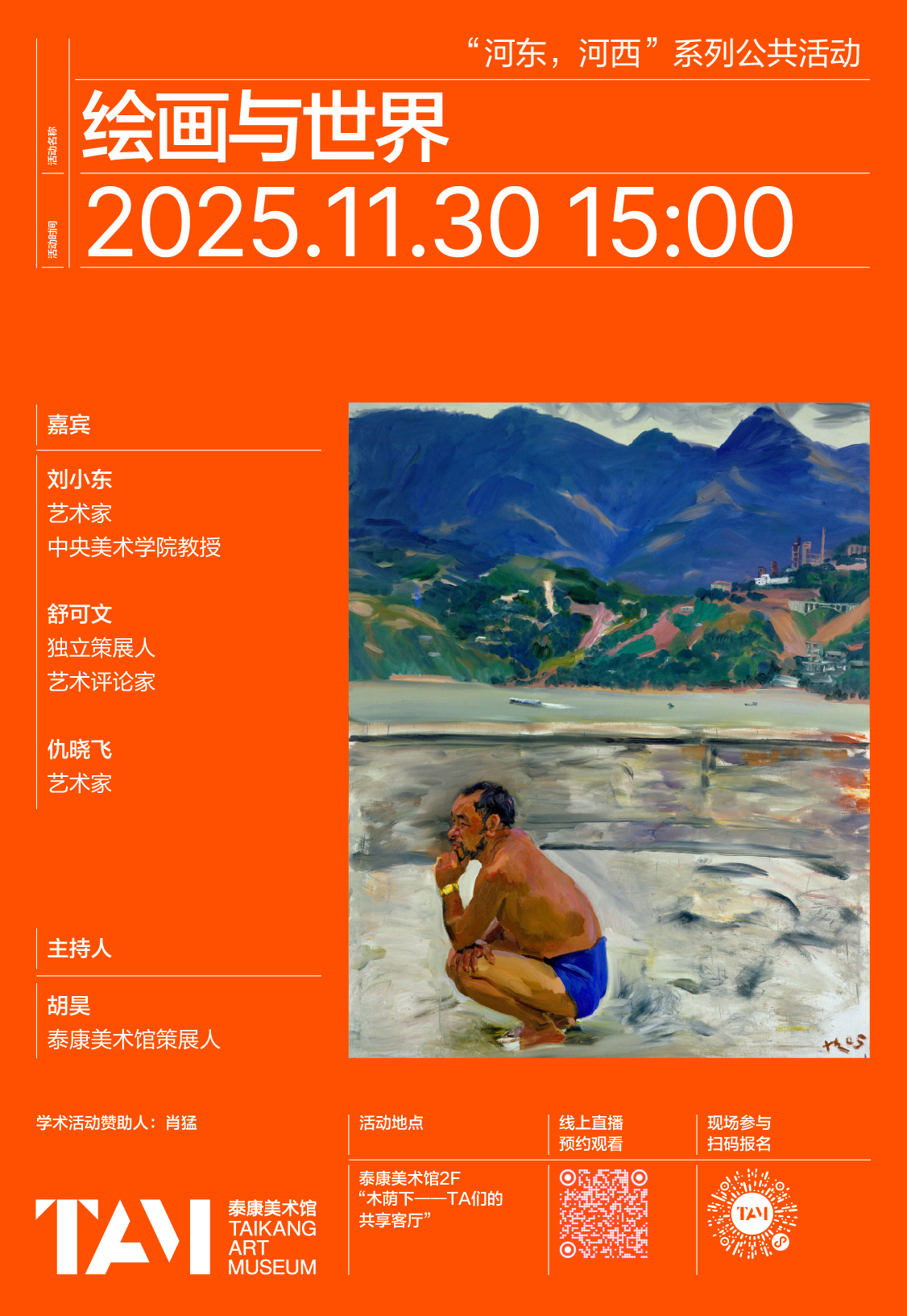


2025.11.30
Painting and the World
- Time2025.11.30 3:00PM—5:00PM
- Venue2F, Taikang Art Museum, Timber Shade - Space for All
- GuestsLiu Xiaodong, Shu Kewen, Qiu Xiaofei
- ModeratorHu Hao
- Tags:

In Liu Xiaodong’s paintings, the world often feels “tangible”—the body is there, the scent is there, time is there. He travels to Jincheng, the Taihang Mountains, the Three Gorges, Yan’an, even Greenland… always carrying his canvas to directly confront people and their lives, treating “being on-site” as a vital way of understanding the world.
In contrast, artist Qiu Xiaofei does not depict external reality. Instead, he reconstructs on canvas these “specters of imagery” from different times and spaces—the grain of old photographs, freeze-frames from newsreels, fragments of memory. Through dreamlike brushstrokes, he lets personal history and grand narratives collide on the canvas, ultimately distilling a “phantasmal reality” that feels both familiar and strange.
These two ways of seeing the world are separated by over a decade—a generational gap that reflects two distinct stances within Chinese society amid the rapid transformations of the 1990s and the 2000s.
The third guest in this conversation is Shu Kewen, a curator and writer. From the perspectives of art history and narrative, she will help us explore: Why are artists of different eras drawn to different forms of “reality”? And in today’s age of image saturation and information overload, can painting still tell stories about the world?
We will discuss:
Why are artists of the 1960s generation inclined to “paint on-site,” while those of the 1970s often draw from images, memory, and nostalgia?
Why have works like Cooperation, so evocative of their era, been rediscovered and reevaluated in the 2000s?
In a present flooded with images and accelerated information, does painting still retain its ability to “construct worlds”?